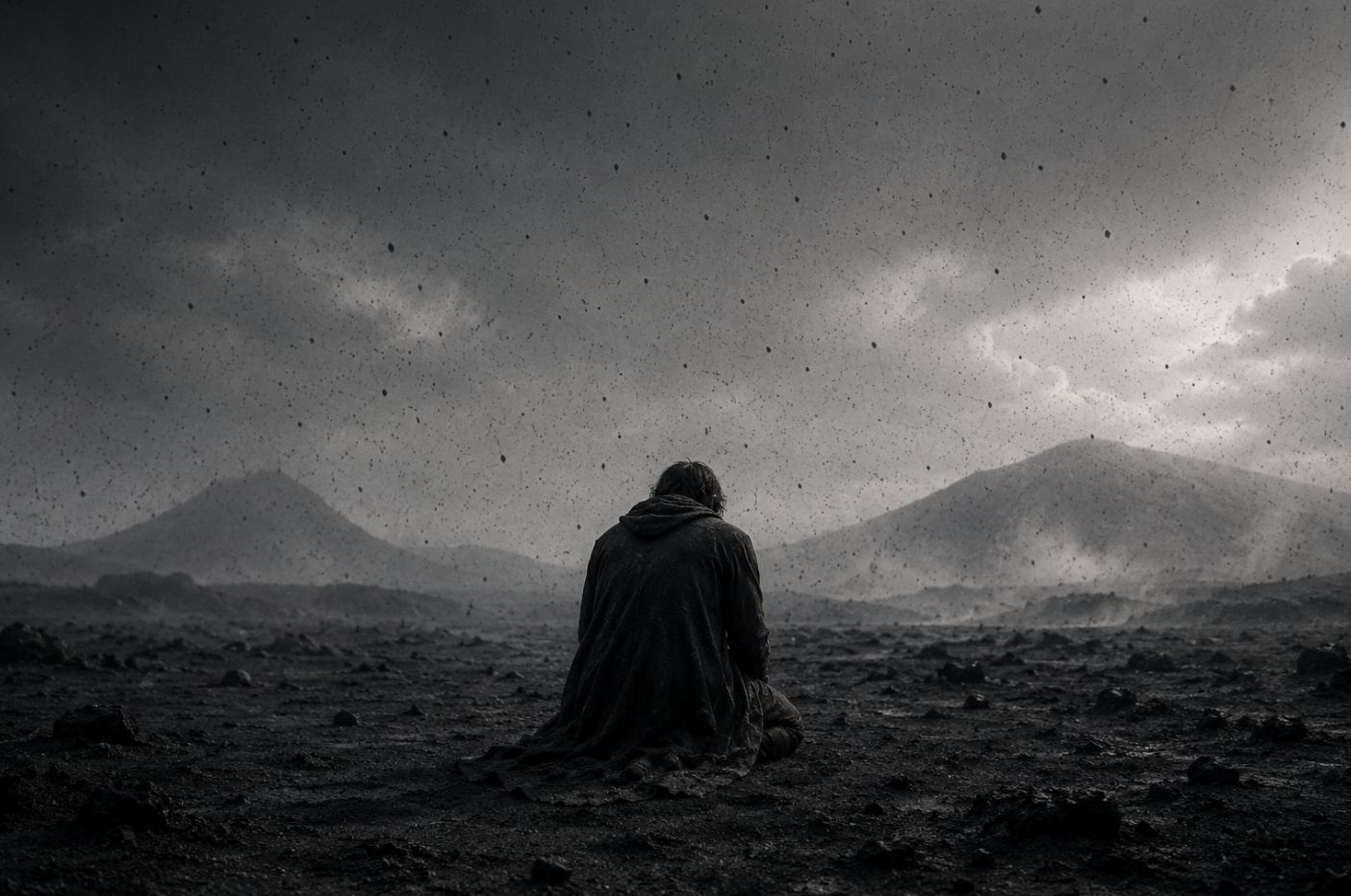
He gazed at the flakes of ash falling from the sky. They continued their silent, relentless discharge against the earth. Like the raven feathers of a soft pillow used to smother a sleeping victim.
"We are doomed," he thought. Behind him, the koloss halted their march, awaiting his silent order. "That's it. It's all going to end."
Understanding this was not oppressive, but gentle, like the last tendril of a dying candle. He suddenly knew they could not fight, that everything they had done over the last year had been for nothing.
Elend fell to his knees. The ash reached his chest. Perhaps this was one last reason he had wanted to walk back. When the others were close, he felt the obligation to appear optimistic. But alone he could face the truth.
And there, in the ash, he finally surrendered.
This dark passage comes from Brandon Sanderson's Mistborn trilogy, a series of novels that made me rediscover fantasy. And, though at first glance it has nothing to do with anxiety, it holds one of the most important lessons any panic sufferer can receive. I say this after years trapped in that hole, and having made it out.
The scene presents us with a duality. On one hand, the darkness: ash chokes the world and foretells its end. On the other, the deep calm that Elend finds when he stops fighting. That second layer is what interests us.
Let us focus on one key phrase: everything they had done over the last year had been for nothing. Elend has spent a year fighting without respite only to discover, in the middle of the ash, that the effort has come to nothing.
We can almost feel the despair, the anguish, the claws of anxiety closing around his chest during that entire year in which he has fought to save his world. A struggle that won him nothing but suffering, anxiety, the catastrophic certainty that the world would reach its end if he stopped fighting.
And then the revelation comes: "We are doomed [...] That's it. It's all going to end." Understanding this was not oppressive, but gentle [...]. He suddenly knew they could not fight.
In that instant, Elend understands that fate does not negotiate. That it is already written, and that whatever he does will not change it. And, paradoxically, all the suffering he has carried for a year dissolves. There is nothing left to defend. Only the peace of having done what he could.
Here comes the most beautiful contrast in this story, and the reason I am writing this post. In Elend, the realisation leads to an ending. In us — those who suffer from panic and anxiety — a surrender like that does exactly the opposite: it sweeps away all the ash and brings back clean air, colour, and the life of this precious blue sphere we are fortunate enough to inhabit.
It astonishes me how the scene traces with such precision the thin line between that living prison, compacted under the weight of the ash of our anxious mind, and the hope that carries us to Morgenrot. To the other side.
Our inner struggle, especially in the form of recurring thoughts, is the main source of fuel for panic. If we do not constantly return to those "What if...?" thoughts, panic cannot rule us. Imagine a pit of quicksand, or of shifting ash. The more you struggle, the deeper you sink. So much so that if you fight without cease you will end up arriving at precisely that apocalyptic scene of dark ash choking all air and colour from your world.
But just as Elend does, there is only one thing you must do. Only one. A single act.
You must surrender. Without conditions. Without qualifications. A final, unconditional surrender.
Once you reach that point, the claws that grip you begin to release and the person you once were starts to re-emerge, strengthened by the resilience you have shown in those dark days. The change is so profound that many of us describe it as magic or a miracle. But it is nothing more than the natural result of a brain that, little by little, stops receiving danger signals. Once you accept your fate, what more can put you in danger?
In Morgenrot I recount a scene of this kind in the beautiful Alpine area of Cuera, in eastern Switzerland. But it was not the only one. You will need to master this technique, accept everything that might happen to you, and repeat it thousands of times, until you emerge from that black hell to which your own brain has dragged you.
I remember another one, much earlier, from my golden days in Granada. I went up for the first time to the Veleta to ski the upper slopes of Sierra Nevada. As soon as I got on the drag lift and saw how the mountain dominated the view, stealing space even from the sky, I felt that familiar twist in my stomach. All I could think was to get off. To stop. I was not going to be capable of skiing such a colossus.
When I reached the top I was trembling all over. And so I stayed as I skied the first gentle slopes, which I'm not sure are a warm-up offer or simply the mountain's mockery of those who dare to challenge it.
All the sensations intensified when I reached the point where the piste seemed to cease to exist, giving way to tiny dark dots on the snow a kilometre below me. Such was the exaggeration of that slope. I felt I was going to vomit and faint.
It was then that I said to myself: well, there is only one way out of this. Either you go down, or you stay up here. And as if by magic, all those sensations evaporated, and I began to descend in an extraordinary blend of calm and excitement.
I was not a person with anxiety at that moment, but it will help you to see how anxiety manifests in many forms, and how in the end there is only one way to beat it and prevent it from growing inside us. Go for it. Accept that anything can happen and ignore those symptoms that want to pull us away from a nonexistent danger. And if something does happen, at least we will have lived standing up.
And you? Do you have an ash moment in your life? Are you ready to commit to going for it, and when anxiety comes in its hardest form, simply to sit down and let it be? If so, congratulations. You have taken one more step on the Morgenrot Trail.